
Choose eye packaging size by formula state, fill quantity and application method, then confirm the complete container and applicator assembly on a drawing and sample. A capacity label alone does not establish wiper fit, powder-pan size, dispensing performance or compatibility with an eye-area formula.
Eye packaging is the smallest format in cosmetics and the least forgiving. A 2 mm change in tube diameter decides which wiper and brush will fit. A pack that is 9 g heavier than the alternative adds 90 kg to every 10,000 units you ship. And an eye cream bottle with a built-in bead is no longer just a container — it is part of how the product is applied.
This guide walks through the sizes in our eye range, what each one is actually built for, and which lines on a spec sheet decide your project — plus the decoration, MOQ and compliance questions that come up before a mould is cut.
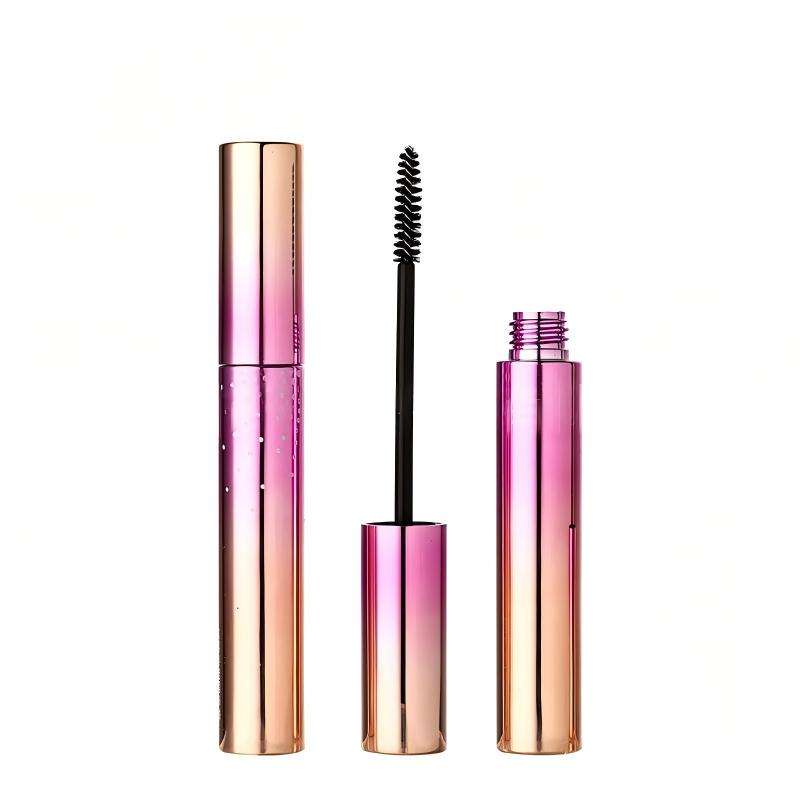
A 13.5 g round mascara tube, model HXPT-SH-0008: 18.7 × 125.5 mm, pack weight 11 g, ABS/AS body with an electroplated finish.
Which formula and fill quantity should you specify first?
The most common specification error we see is a brand choosing a tube by its marketing size and then discovering the fill weight does not match. Two tubes of the same nominal capacity can differ substantially in pack weight, and pack weight is what your freight and carton maths is built on.
Across our eye range, at the published MOQ of 12,000 pieces per model, the differences are measurable:
| Format | Pack weight (per unit) | Net weight at 12,000 pieces per model |
|---|---|---|
| Slim 2.5 ml brow / lash tube (HXPT-JX-8449) | 6.8 g | 68 kg |
| 13.5 g round mascara tube (HXPT-SH-0008) | 11 g | 110 kg |
| 10 ml round mascara tube (HXPT-JX-8451) | 20 g | 200 kg |
| 15 / 20 ml roller eye cream bottle (HXPT-JX-8204) | 44 g | 440 kg |
The 2.5 ml tube and the 20 ml bottle sit at opposite ends of that table. The two mascara tubes that look most alike on a shelf — 10 ml at 20 g and 13.5 g at 11 g — are 9 g apart per unit, which is 90 kg over a 10,000-piece order. If your formula is dense and your dose per use is small, the lighter body may be the better decision: not because it costs less, but because it moves less mass and takes less warehouse space.
Two practical consequences:
1. Decide the dose per application before the container. A 2.5 ml tube and a 20 ml bottle are not interchangeable at the same retail price point; they imply different usage rates and different repurchase cycles.
2. Ask for the pack weight in grams, not the “capacity” alone. A supplier that quotes only millilitres has not given you enough to plan freight.
Which dimensions matter for mascara and lash serum tubes?
Our eye range carries three distinct tube families, and the differences between them are structural rather than cosmetic.
| Model | Capacity | Size (mm) | Weight | Material | Built for |
|---|---|---|---|---|---|
| HXPT-JX-8449 | 2.5 ml | 13.5 × 13.5 × 90 | 6.8 g | Plastic | Brow tint and dye, lash serum, sample and travel formats |
| HXPT-JX-8451 | 10 ml | 16 × 16 × 116.6 | 20 g | Plastic | Mascara, lash growth serum, eyeliner, brow gel |
| HXPT-SH-0008 | 13.5 g | 18.7 × 125.5 | 11 g | ABS/AS | Mascara, lash primer, brow gel, lash growth serum |
Three points worth noting from that table:
The 2.5 ml tube is the wand-flexible one. Its applicator can be swapped — mascara brush, flocked lip wand or fine liner brush — which makes it the practical choice for brow tints, hair tamers and liquid makeup DIY formats where the brush defines the product. Its 13.5 mm diameter is the narrowest in the range.
The 10 ml tube is the standard workhorse. Clear cylindrical body, glossy black cap, spiral brush applicator. The transparent body lets the remaining volume be seen, which matters for products where visible depletion is part of the user experience.
The 13.5 g tube is about shelf presence. It is the heaviest-capacity tube here, and it is finished by electroplating in gold, black or gradient — a metallic surface that photographs and displays differently from a plain tube. Note that its thread fit between cap and body is the sealing feature: reliable sealing is what prevents a paste formula from drying out or leaking in transit, and that is the specification to test, not the finish.
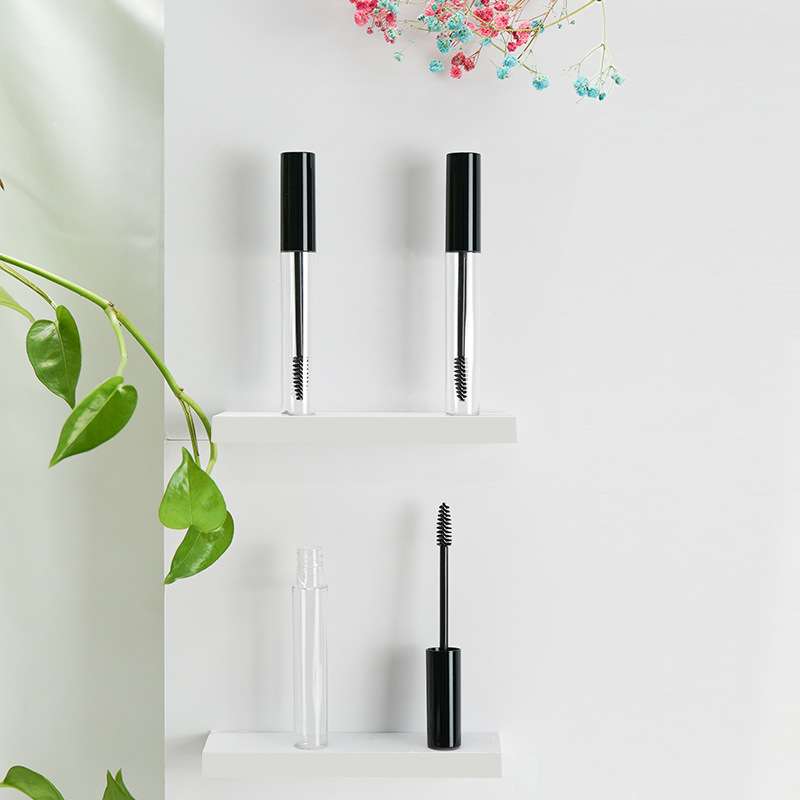
The 10 ml round mascara tube, model HXPT-JX-8451: 16 × 16 × 116.6 mm, 20 g, clear body with a spiral brush applicator.
Powder formats: the 3 g ice-cube pot versus the 5 g compact
The two powder containers in the range solve different problems, and the decision usually comes down to pan geometry rather than capacity.
| Model | Capacity | Size (mm) | Inner structure | Built for |
|---|---|---|---|---|
| HXPJ-ZD-0002 | 3 g | 35 × 35 × 27.2 | Embossed heart or seashell inner mould | Single-colour eyeshadow, blush, lip mud |
| HXPB-YM-7216 | 5 g | 56 × 60 × 16 (cavity / puff dia. 41 mm) | Flip-top lid with built-in aluminium pan | Eyeshadow, blush, highlighter, pressed powder, concealer |
The 3 g pot trades footprint for height and detail. At 35 × 35 × 27.2 mm it is compact in plan but taller than the 5 g compact, and its transparency is the selling point: the pressed powder inside is visible, and the embossed inner mould shapes the cake itself into a heart or shell. That shape is a filling consideration — it constrains how the powder is pressed, so it should be discussed with whoever fills the pan, not chosen at the artwork stage.
The 5 g compact is the flatter, wider format. Its 41 mm cavity diameter sets the maximum pan size and therefore the maximum practical puff diameter. The milky frosted finish hides fingerprints better than a glossy surface, and the frosted body also affects how the powder colour reads through the pack — worth checking with a filled sample rather than a rendering.
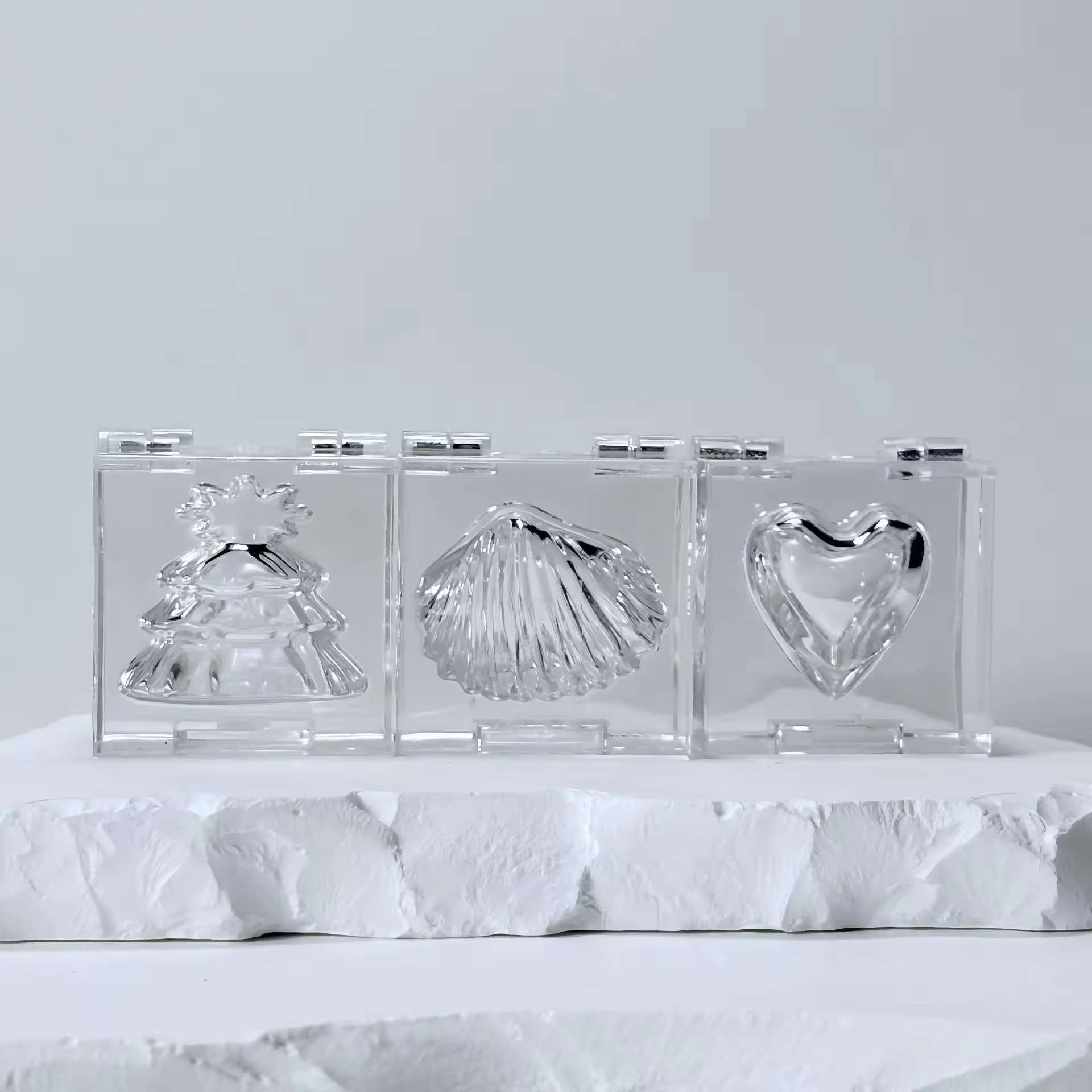
The 3 g ice-cube pot, model HXPJ-ZD-0002: 35 × 35 × 27.2 mm, with an embossed inner mould that shapes the pressed powder.
Eye cream and serum bottles: the bead is the specification
Both roller bottles in the range hold eye cream and eye serum, and both carry a massage bead. The differences are the outer form and the bead material.
| Model | Capacity | Size (mm) | Weight | Outer form | Bead |
|---|---|---|---|---|---|
| HXPT-JX-8204 | 15 / 20 ml | 25 × 25 × 157 | 44 g | Diamond-cut faceted outer tube, high-transparency | Metal ball roller head |
| HXPT-JX-8414 | 10 / 15 / 20 ml | 20.5 × 20.5 × 139 mm and 25 × 25 × 158 mm | 38.5 g / 44 g | Vertical striped (ridged) texture | Plastic rolling bead |
HXPT-JX-8204 is the premium presentation option: a faceted outer tube that reads as crystal-cut, with a metal ball in the head. Its construction is a sealed pump with an inner tube, which is the feature that keeps a low-viscosity serum from leaking over a long shelf life. It is also the heavier of the two at 44 g.
HXPT-JX-8414 offers a wider capacity span from 10 ml upward, a ridged vertical texture, and a plastic rolling bead. Its refillable construction is aimed at brands that want a reusable pack with refill as part of the story.
A note on the bead, since it is the part most often chosen for the wrong reason: a metal ball and a plastic bead do not feel the same on the skin, and they do not interact with a formula the same way. Neither is universally better. The specification that matters is compatibility and stability of your specific formula against the specific bead material — which is a test on the physical pack, not a data sheet question.
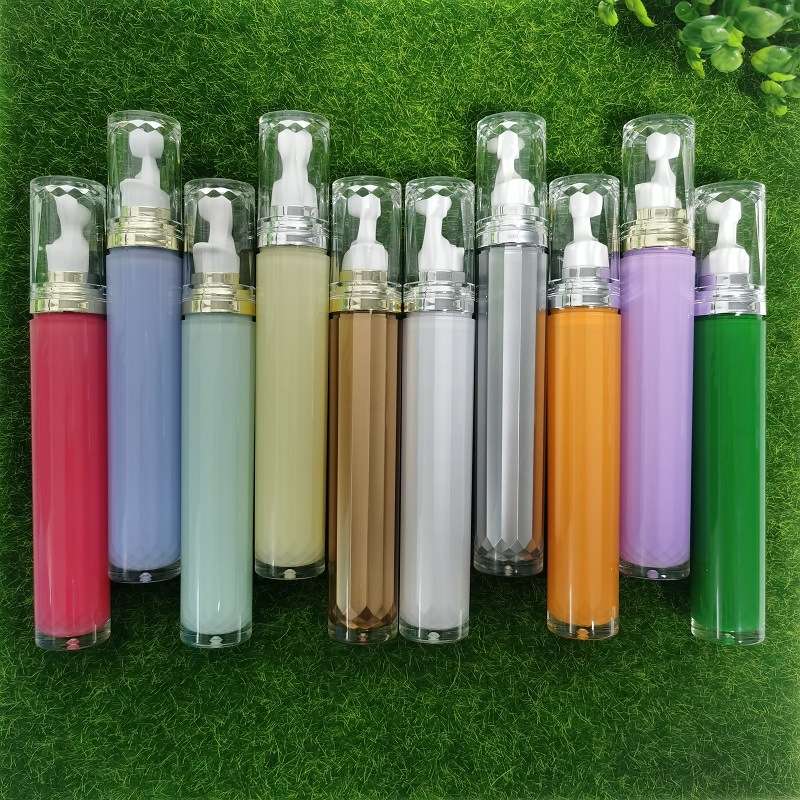
The 15 / 20 ml roller eye cream bottle, model HXPT-JX-8204: 25 × 25 × 157 mm, 44 g, with a metal ball roller head and sealed pump construction.
The nine lines on a spec sheet that decide your project
Every item in our eye range is documented against the same fields. This is what each one actually controls.
| Field | Our eye range | Why it decides your project |
|---|---|---|
| Material | e.g. ABS/AS (HXPT-SH-0008); plastic with a high-transparency acrylic-look outer (HXPT-JX-8204) | Chemical compatibility with your formula, and the starting point for any recyclability assessment |
| Capacity | 2.5 ml to 20 ml across the range | Must be matched to fill weight and dose per use, not to the marketing name |
| Size | e.g. 16 × 16 × 116.6 mm; 18.7 × 125.5 mm; 35 × 35 × 27.2 mm | Carton count, freight, shelf presence, and whether your wand or pan fits |
| Weight | 6.8 g to 44 g | Direct input into freight and warehouse planning per order quantity |
| Model number | e.g. HXPT-JX-8451, HXPB-YM-7216 | The reference a repeat order is placed against — keep it in your own system |
| Colour | Customisation | Where the brand palette is applied |
| Customisation | Logo, colour, surface treatment, material | The four levers available on every item in the range |
| Handling | Silk printing, hot stamping, UV coating, electroplating | The main cost and lead-time variable after the mould |
| Supply ability | 3,000,000 pieces per month | Whether your launch schedule is realistic |
Decoration: where the cost and the lead time actually move
All seven eye items are documented with the same four decoration routes — silk printing, hot stamping, UV coating and electroplating — and most are also open to colour printing and glossy lamination.
Our 2.5 ml brow and lash serum tube page is currently the only item in the eye range that publishes decoration pricing, and it is worth reading as an illustration of how these charges are structured rather than as a general price list:
- Logo / pattern: from $0.45 per piece, minimum order 100 pieces
- Printing handling: from $0.05 per piece, minimum order 12,000 pieces
Two things follow. First, decoration carries its own minimum order, which can sit above or below the 10,000-piece container MOQ — on this item the printing minimum of 12,000 is higher than the product MOQ, so the printing threshold is the one that governs. Second, decoration is quoted as a separate per-piece charge, so a plain body and an electroplated one should be compared on a written quotation before artwork is locked rather than treated as an aesthetic-only decision.
MOQ and lead time: the schedule you are planning against
Specifications are published with a minimum order quantity of 12,000 pieces per model, and our standard process runs as follows:
- Samples with custom colours and printing take 5–7 days to prepare.
- A 30% deposit is required before production begins.
- Bulk production takes 25–35 days for items not held in stock.
- Delivery generally takes around 25–30 days after order confirmation.
The planning implication is straightforward: a four-item eye range launch means four separate 10,000-piece commitments rather than one. If you are developing an eye line from scratch, sequence it — lead with the format that carries your hero product, and add the powder and cream formats once the first pack has cleared stability testing.
The compliance question that now sits on top of every eye pack
Eye packaging has not been exempted from the EU Packaging and Packaging Waste Regulation. Our component-mapping checklist for PPWR singles out the eye and mascara component specifically: the wiper, stem and brush are mixed materials in a small format, which makes them a separation and identification problem rather than a volume one.
For compacts, the volume conversation runs the other way: the compact base, the aluminium pan, the mirror and the puff all have to be mapped, and a built-in mirror or puff is generally not packaging — which changes how the empty-space calculation has to be documented.
We covered the regulation’s dates, grades and the format-by-format risk map in a separate article — PPWR Is Live: What EU Beauty Brands Now Need From Their Packaging Supplier. If your eye range is sold into the EU, read that alongside this sizing guide: the two decisions are made in the same project, and the second one has a deadline.
How Fengyuanbeauty can help
We supply empty cosmetic packaging components across lip, face, eye and squeeze-tube formats, and we are used to being asked for specifications rather than reassurance. For an eye range, we can provide per item:
- the full specification sheet — material, capacity, size, weight, model number and decoration routes;
- physical samples so your lab can run formula compatibility, stability and drop testing on the actual pack;
- decoration options quoted side by side, so a plain body and an electroplated one can be compared on cost before artwork is locked;
- component-level material data for the PPWR mapping described above.
You can request samples through our Get Sample page, see how each batch is controlled under Quality Control, or read about tooling and development in OEM & ODM Solution. For a specific component question, contact us with your format, fill weight and target market.
Browse our components by category: Lip Package · Face Package · Eye Package · Squeeze Tube Package.
All dimensions, capacities and weights in this article are the published specifications for the models named. Pack weight varies with colour, decoration and finish, so confirm the final figure against your own approved sample before you plan freight.
FAQ
Which mascara tube size should I choose for a lash serum?
It depends on your dose per use and intended repurchase cycle rather than on the product name. The 2.5 ml slim tube (HXPT-JX-8449) suits brow tints, sample sizes and travel formats, and it accepts interchangeable wands — mascara brush, flocked lip wand or fine liner brush. The 10 ml tube (HXPT-JX-8451) is the standard clear-body format used for mascara, lash serum and eyeliner. The 13.5 g tube (HXPT-SH-0008) provides the largest capacity in the tube range with an electroplated finish for shelf presence. Because the wand and wiper have to match your formula’s viscosity, we recommend testing on physical samples.
Should I choose a metal massage bead or a plastic one?
There is no universally better option. The 15 / 20 ml bottle (HXPT-JX-8204) uses a metal ball roller head; the 10 / 15 / 20 ml ridged bottle (HXPT-JX-8414) uses a plastic rolling bead. Metal and plastic feel different in use, and they interact with a formula differently over time. The deciding factor is the compatibility and stability result for your specific formula against the specific bead material, which can only be established by testing the physical pack.
What is your minimum order quantity for eye packaging?
The published MOQ is 12,000 pieces per model across the eye range. Each model carries its own MOQ, so a range of four items means four separate commitments. Decoration may carry a different minimum — for example, the 2.5 ml brow and lash serum tube lists printing handling from $0.05 per piece with a minimum order of 12,000 pieces, which is above the container MOQ. Confirm the applicable threshold for your chosen model and decoration with our sales team.
How long does a custom eye packaging order take?
Confirm sample availability, charges, dispatch timing, production lead time, payment and inspection scope in the current written quotation. These depend on the model, customization, quantity and destination. Keep the approved sample and final specification with the order records.
Will you sign an NDA for a custom design?
Yes. We work on OEM and ODM projects and will sign an NDA where required, so artwork is not shared with other clients and OEM items are not sold to anyone else. We can work from JPG, AI, CDR or PDF files and will produce a 3D drawing or printing screen for your confirmation.
Sources
- Fengyuan — Eye Package category (all seven items with published specifications): fymakeup.com/product-category/eye-packaging
- Fengyuan — Empty 2.5 ml mascara tube for eyebrow dye and lash serum, model HXPT-JX-8449: product page
- Fengyuan — Empty 10 ml round mascara tube, model HXPT-JX-8451: product page
- Fengyuan — Empty 13.5 g round mascara tube, model HXPT-SH-0008: product page
- Fengyuan — Empty 3 g ice-cube eyeshadow and blush pot, model HXPJ-ZD-0002: product page
- Fengyuan — Empty 5 g compact box, model HXPB-YM-7216: product page
- Fengyuan — Empty acrylic eye cream bottle 15–20 ml with massage bead, model HXPT-JX-8204: product page
- Fengyuan — Empty eye cream bottle 10–20 ml with massage bead, model HXPT-JX-8414: product page
- Fengyuan — PPWR Is Live: What EU Beauty Brands Now Need From Their Packaging Supplier: blog article
Which evidence should support the final packaging decision?
Use the chosen model’s drawing, component list and approved sample as the project record. For the safety-assessment context of packaging in contact with cosmetics, consult the EU guidance on the cosmetic product safety report. This regulatory reference is not a test result or approval for a particular Fengyuan model.
What is the next step for your packaging project?
Browse the relevant packaging collection, review customization options, and request a model-specific sample. Send the model reference, intended formula or format, quantity and any open questions so the response can address your actual order.
Publisher: Fengyuan · Existing article credit: Fengyuanbeauty · Content updated 18 November 2026. Product and company details should be checked against the company profile and current written specification; sample checks are project-specific.