
Choose face packaging by the formula format, target fill and dispensing method, then confirm the inner container, closure and external dimensions. Cushion cases, powder compacts, liquid bottles and cream jars solve different filling and application tasks; no single footprint or nominal capacity is a universal specification.
Face packaging is the one category where the container is a system rather than a single part. A cushion case is a case, a refill or inner cup, a sponge holder, a puff and sometimes a mirror. A powder box is a base, a lid, a sifter or mesh, a seal and a pan. That is why the fill figure on a face spec sheet tells you less than it does anywhere else in cosmetics — and why pairs of items that look interchangeable often are not.
Across our face range the numbers spread from 3 g to 300 ml of fill, over five distinct format families and 34 items. This guide to face packaging sizes walks through each family, and through the specification lines that decide whether your project works.
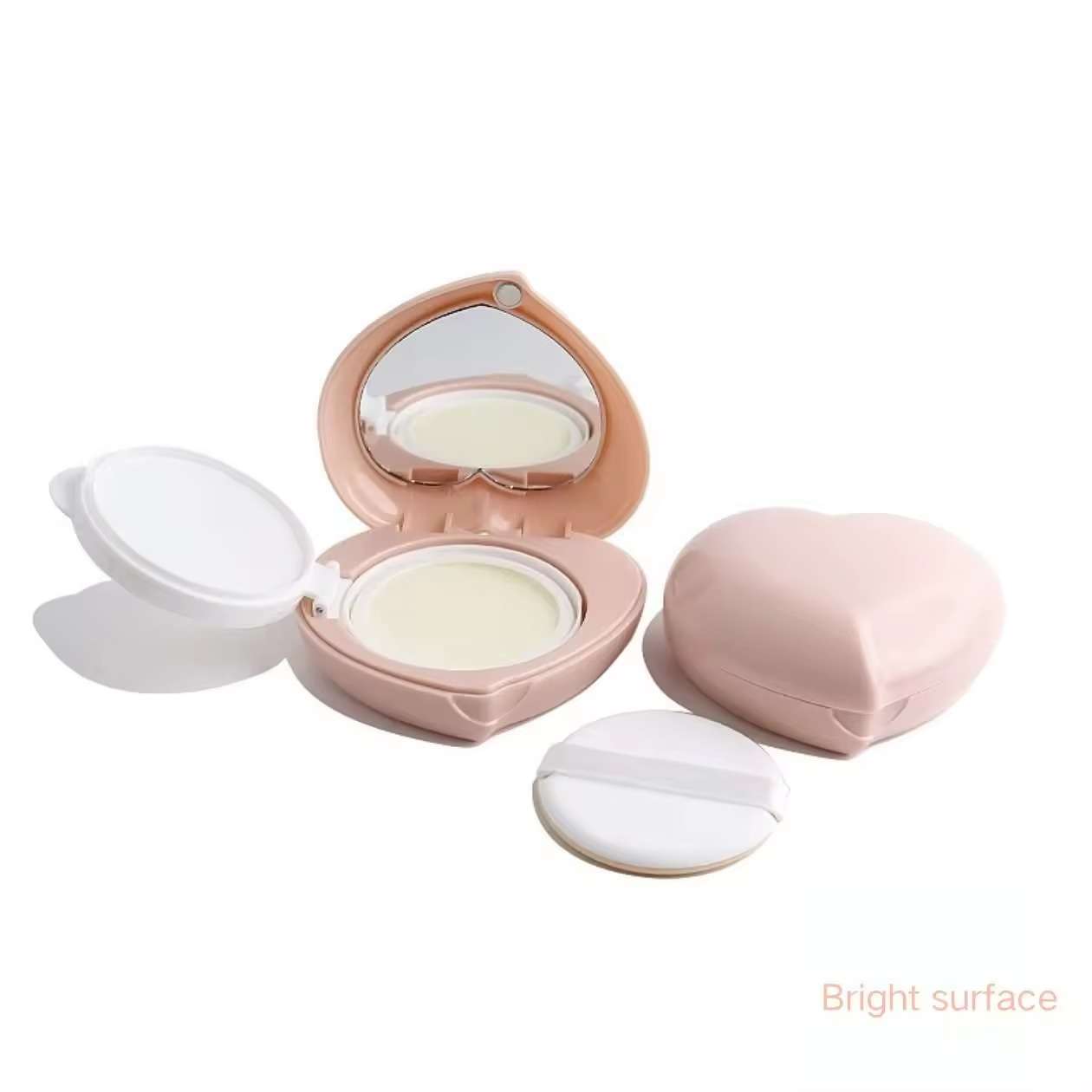
A 15 g air cushion compact in an ABS + PP shell: 84 × 75 × 33 mm, with a 45 mm inner well, a 53 mm puff compartment and a mirror in the lid.
Which face packaging format fits each formula?
| Family | Items | Fill range | Footprint range |
|---|---|---|---|
| Air cushion cases | 11 | 5 g – 56 g | 73 × 73 × 27 mm to 84 × 75 × 33 mm |
| Powder compacts & boxes | 8 | 3 g – 20 g | 56 × 60 × 16 mm to 84 × 75 × 15 mm |
| Foundation & lotion bottles | 3 | 20 ml – 100 ml | 31 mm diameter, 106–162 mm tall |
| Jars | 5 | 20 g – 300 ml | 46 × 45.5 mm to 102 × 102 × 53 mm |
| Twist-up sticks | 4 | 6 g – 50 g | 27.5 × 27.5 × 63 mm to 45 × 45 × 90 mm |
Which dimensions and seals should buyers check on a cushion case?
Most cushion cases in the range are built around the same 76 mm round footprint, and the fill figure moves independently of the case size.
| Fill | Case size | Cavity / puff diameter | Material |
|---|---|---|---|
| 13 g | 76 × 30 mm | — | ABS + PP |
| 13 g | 81 × 29 mm | — | AS |
| 15 g | 76 × 28.5 mm | — | Plastic |
| 15 g | 84 × 75 × 33 mm | 45 mm / 53 mm | ABS + PP |
| 12–15 ml | 74 × 74 × 31 mm | — | Plastic |
| 56 g | 73 × 73 × 27 mm | 58 mm | Plastic |
| Mushroom shape | 76 × 37 mm | — | Plastic |
| 12 g (two items) | not recorded | — | ABS |
| 5 g (two items) | 20 × 63 mm on one; the other records no size | — | ABS / PP and AS |
Two things in that table are worth reading carefully.
The 13 g and 15 g cases share the same 76 mm footprint, and the 13 g one is deeper. The 13 g case is 30 mm tall; one of the 15 g cases is 28.5 mm. So the nominal fill figure is describing the cushion or refill that sits inside, not the internal volume of the case. If you choose a cushion case by its gram figure and then order refills to match, you are matching the wrong number — ask for the cavity diameter and depth instead, which is what the refill actually has to fit.
Cavity diameter is a specification, not a detail. It runs from 45 mm to 58 mm in this range, and it fixes the maximum puff diameter and the refill size you can use. The 15 g heart case carries a 45 mm inner well with a 53 mm puff compartment; the 56 g case carries a 58 mm cavity and ships with a honeycomb sponge holder. A puff is not an accessory you add later — on a cushion it is dimensioned by the case.
On materials, the common pairing is ABS for the outer shell and PP for the inner cup — the shell gives the case its hand feel and the inner cup is what contacts the formula. One 13 g case is specified in AS rather than ABS.
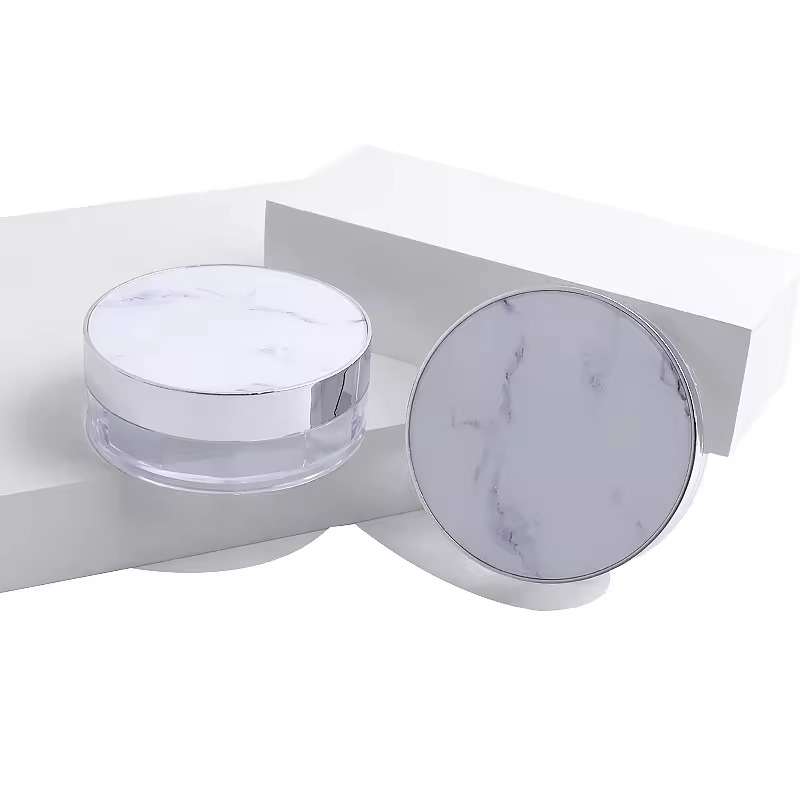
A 15 g marble powder box: 76 × 29 mm with a 48 mm cavity and a 46 × 16 mm inner well, ABS lid over a clear PS body, elastic mesh layer to hold the puff.
Powder compacts and boxes: 15 mm thin versus 38 mm deep
The depth of a compact is the number that tells you what is inside it. Everything in this family is 70–84 mm across, so the footprint barely narrows the choice — the depth does.
| Fill | Outer size | Depth | Pan / cavity | What is inside |
|---|---|---|---|---|
| 3 g | 76 × 16 mm | 16 mm | — | Loose powder, flip cover, ABS + PS |
| 5 g | 56 × 60 × 16 mm | 16 mm | 41 mm | Aluminium pan, flip-top |
| 5 g | 60 × 60 × 16 mm | 16 mm | — | Flip-top, AS body |
| 6 g | 44 × 50 × 31 mm | 31 mm | — | Heart-shaped, ABS |
| 15 g | 76 × 29 mm | 29 mm | 48 mm; 46 × 16 mm well | Elastic mesh, puff included |
| 20 ml | 75 × 75 × 15 mm | 15 mm | — | Single-layer powder pan |
| 20 g | 70 × 70 × 38 mm | 38 mm | — | Mirror and puff compartment |
| Powder | 84 × 75 × 15 mm | 15 mm | — | Oval body with mirror |
A 15 mm body and a 38 mm body of nearly the same footprint are not two versions of one product. The 15 mm bodies are single-layer pans: a base and a lid with the powder in between. The 38 mm body has a mirror and a puff compartment stacked on top of the pan. If your brief says “compact with mirror” and you quote against a 15 mm body, there is nowhere for the mirror to go — and the reverse is just as expensive, because a 38 mm body with an empty upper deck looks and photographs like a mistake.
For a straight pan comparison, the 15–16 mm group is the one to work through: 76 × 16 mm, 56 × 60 × 16 mm, 60 × 60 × 16 mm, 75 × 75 × 15 mm and 84 × 75 × 15 mm. Five footprints, one depth, four material pairings — that is the point where a face range stops being about size and starts being about shape and finish.
Foundation and lotion bottles: one diameter, three heights
The bottles in this range divide cleanly into a small-diameter family and a square family.
| Capacity | Size | Weight | Type |
|---|---|---|---|
| 20 / 30 / 50 ml | 31 × 31 × 106 / 124 / 162 mm | 30.5 / 33 / 40.5 g | Airless pump, frosted body |
| 30 ml | 37.5 × 37.5 × 117 mm | 56 g | Double-layer foundation pump |
| 30 / 50 / 100 ml | 45 × 45 × 60 mm | 73 / 92 / 130 g | Square acrylic lotion bottle |
The 31 mm family is the most efficient range extension in the catalogue. All three fills share the same diameter, which means the same pump, the same collar and the same cap — only the body length changes between 106 mm, 124 mm and 162 mm. For a brand launching three SKUs at once, that is three products with one closure tooling. The pump is an airless design, which is the specification that keeps a low-viscosity lotion or foundation from oxidising and from leaving product stranded in the bottle.
Keep empty packaging weight, intended fill and packed-shipment weight separate when comparing freight. Request the actual unit and carton data for the proposed configuration; a capacity difference alone does not establish its shipping cost.
The square acrylic lotion bottle is the outlier at 73–130 g depending on fill, which is what an acrylic wall costs. If the product is positioned as premium skincare rather than volume foundation, that is the pack that carries it.
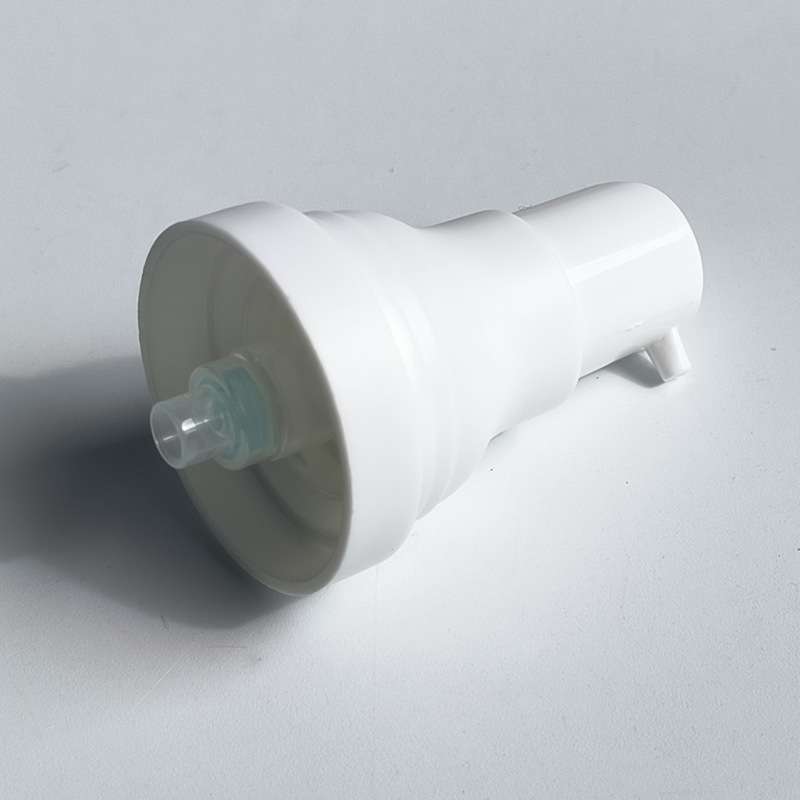
The 31 mm airless pump bottle family: three fills on one body diameter, 106 / 124 / 162 mm tall, with a frosted finish and an airless pump.
Jars: why a 20 g jar can weigh more than a 300 ml one
This is the most counterintuitive comparison in the range, and the one most likely to be got wrong at quoting stage.
| Capacity | Size | Weight | Material | Typical use |
|---|---|---|---|---|
| 20 g | 46 × 45.5 mm | 43.8 g | PP + AS | Refillable cream or lip mask jar |
| 5 ml | 43 × 43 × 32 mm | — | PP | Double-layer frosted jar |
| 200 g | 81 × 83 mm | — | PP | Wide-mouth makeup remover jar |
| 300 ml | 102 × 102 × 53 mm | 36 g | PP | Wide-mouth aloe gel and mask jar |
The 20 g jar is heavier than the 300 ml jar — 43.8 g against 36 g. Fifteen times the fill, at 82% of the pack weight. Nothing is wrong with either figure: the 20 g jar is a thick-walled, two-material (PP + AS) container built to feel substantial in the hand, while the 300 ml jar is a thin-wall PP vessel where the wall is doing nothing except holding the product. If you compare them by capacity you will conclude the 300 ml jar is the expensive one to ship. It is the cheaper one.
The rule this points to is the same one that runs through the rest of the range: wall thickness and material pairing set pack weight, not fill. Ask for the pack weight in grams, and ask what the wall is.
Twist-up sticks: the 20 g and 30 g pair share one pack weight
Solid formats use a twist-up mechanism rather than a pan or a pump, and the range spans 6 g to 50 g.
| Fill | Size | Weight | Typical fill |
|---|---|---|---|
| 6–8 g | 27.5 × 27.5 × 63 mm | 18 g | Solid balm |
| 20 g | 47 × 20 × 86 mm | 35.8 g | Blush and sunscreen stick |
| 30 g | 38 × 76 mm | 35.8 g | Blush and mud mask |
| 50 g | 45 × 45 × 90 mm | 45 g | Mask and sunscreen |
The 20 g and the 30 g sticks carry the same 35.8 g pack weight. A 50% fill increase at no freight cost at all — if you are choosing between them, the only remaining question is which silhouette suits the product, because the shipping cost is identical per unit.
And the jump to 50 g — two and a half times the 20 g fill — adds 9.2 g per unit, or 92 kg per 12,000 pieces per model. Measured against the freight penalty you pay for a slightly larger gloss tube, capacity in a stick format is close to free.
Materials across the face range
| Material | Items | Where it appears |
|---|---|---|
| Plastic — polymer not named | 15 | Cushion cases, compacts, bottles, sticks |
| PP | 5 | Jars, twist-up sticks |
| AS | 4 | One cushion case, compacts |
| ABS | 3 | Cushion cases, heart blush compact |
| ABS + PP | 3 | Cushion cases, powder boxes |
| ABS + PS | 1 | 3 g loose powder box |
| PP + AS | 1 | 20 g refillable cream jar |
| ABS / PP | 1 | 5 g mini cushion case |
| Acrylic | 1 | 30–100 ml square lotion bottle |
| Total | 34 |
Where a face pack has a contact surface, PP is the material that appears most often — the inner cup on a cushion case, the jars, the stick bodies. Where the pack has to feel premium in the hand, ABS or acrylic is doing that job on the outside.
As in the rest of our catalogue, 15 of the 34 items publish their material simply as “Plastic” without naming the polymer. That is enough to order against, but it is not enough to run a compatibility screen against your formula, and it is not enough for a recyclability assessment under PPWR — both of which need a named resin. Ask for the specific polymer on any item you are seriously evaluating, and we will confirm it per component.
PPWR: face packaging carries the two hardest rows
Of all the formats we map for the EU Packaging and Packaging Waste Regulation, the cushion compact is the one with the most components. Our component-mapping checklist sets it out like this:
- Cushion compact (13 g / 15 g) — case, base, mirror, puff, inner tray, sponge, seal. The mirror and the sponge are generally not packaging items, the case is multi-material, and the refill design has to be documented. Evidence to request: bill of materials, refill compatibility, justification for added volume.
- Loose powder box — base, lid, sifter or mesh, seal, decoration. The risk sits in the sifter mesh as a second material, and in an over-sized base chosen for shelf presence rather than for the product.
- Airless pump / foundation bottle — actuator, housing, spring, ball, gasket, dip tube, bottle, overcap. Multiple polymers, a metal spring, elastomer gaskets, and separability. This is the row where the 31 mm airless family above will be asked the most questions.
The practical consequence for a face brand is that the empty-space requirement and the component map are connected. Because a mirror and a puff are generally not counted as packaging, the empty-space calculation for a compact with a mirror deck has to be documented differently from a plain pan of the same footprint — and that calculation is one you want to be able to justify with test evidence rather than assert.
The framework has applied since 12 August 2026. Design-for-recycling grades — Grade A at 95%, B at 80%, C at 70% — are generally required from 1 January 2030, and Grade C is no longer sufficient from 1 January 2038. The harmonised material and sorting label applies from 12 August 2028, or 24 months after the relevant implementing act, whichever is later, and packaging cannot exceed a maximum 50% empty space under specified conditions.
We covered the dates, grades and the full risk map in a separate article: PPWR Is Live: What EU Beauty Brands Now Need From Their Packaging Supplier.
Decoration, MOQ and the schedule you are planning against
Every item in the face range is published with a minimum order quantity of 12,000 pieces per model, and every one is open to logo, colour, surface treatment and material customisation. Finishing routes are silk printing, hot stamping, UV coating and electroplating, with colour printing, glossy lamination and gold stamping also available on selected formats.
Decoration is quoted as a separate per-piece charge, and the items where we publish those rates show a consistent structure — for example the 56 g round air cushion case:
- Logo / pattern: from $0.45 per piece, minimum order 100 pieces
- Printing handling: from $0.05 per piece, minimum order 12,000 pieces
As with the container, decoration can carry its own minimum that sits above the 10,000-piece product MOQ, so the printing threshold is sometimes the one that governs the order. Confirm the applicable threshold for your model and artwork before you cost the launch.
The production schedule is the one we quote across the range:
- Samples with custom colours and printing take 5–7 days to prepare.
- A 30% deposit is required before production begins.
- Bulk production takes 25–35 days for items not held in stock.
- Delivery generally takes around 25–30 days after order confirmation.
How Fengyuanbeauty can help
We at Fengyuanbeauty supply empty cosmetic packaging components across lip, face, eye and squeeze-tube formats, and we are used to being asked for specifications rather than reassurance. For a face range, we can provide per item:
- the full specification sheet — material, capacity, size, weight, cavity diameter and decoration routes;
- physical samples so your lab can run formula compatibility, stability and drop testing on the actual pack;
- case, refill, puff and mirror combinations quoted together, so the cavity and the accessories are confirmed before tooling;
- component-level material data and refill documentation for the PPWR mapping described above.
You can request samples through our Get Sample page, see how each batch is controlled under Quality Control, or read about tooling and development in OEM & ODM Solution. For a specific component question, contact us with your format, fill weight and target market.
Browse our components by category: Face Package · Lip Package · Eye Package · Squeeze Tube Package.
All dimensions, capacities and weights in this article are the published specifications for the models named. Pack weight varies with colour, decoration and finish, so confirm the final figure against your own approved sample before you plan freight.
FAQ
Should I choose a 13 g or a 15 g air cushion case?
Both sizes are built on the same 76 mm footprint, and the deeper of the two is actually the 13 g case at 30 mm against 28.5–29 mm for the 15 g ones. The fill figure describes the cushion or refill inside the case, not the case capacity, so choosing by gram figure can send you looking for the wrong refill. Compare the cavity diameter (45 mm to 58 mm across the range) and the case depth, and confirm the refill you intend to use fits that cavity.
Why does a 20 g cream jar weigh more than a 300 ml jar?
Because wall thickness and material pairing set pack weight, not fill. Our 20 g refillable cream jar weighs 43.8 g — it is a thick-walled container built from PP and AS to feel substantial in the hand — while the 300 ml wide-mouth jar weighs 36 g, because it is a thin-wall PP vessel. Fifteen times the fill at 82% of the pack weight. Always ask for the pack weight in grams per unit before planning freight.
Do your powder compacts come with a mirror and a puff?
It depends on the depth, not the footprint. The 15–16 mm bodies in the range are single-layer pans (76 × 16 mm, 56 × 60 × 16 mm, 60 × 60 × 16 mm, 75 × 75 × 15 mm, 84 × 75 × 15 mm) with no upper deck, so there is no room for a mirror or a puff compartment. The 38 mm body at 70 × 70 mm has both. Tell us whether the pack needs a mirror before artwork is locked, because it changes which bodies can be quoted.
What is the minimum order quantity for face packaging?
The published MOQ is 12,000 pieces per model across the face range. Each model carries its own MOQ, so a range of four items means four separate commitments. Decoration can carry a different minimum — printing handling is listed from $0.05 per piece with a minimum order of 12,000 pieces on some items, which sits above the container MOQ. Confirm the applicable threshold for your chosen model and decoration with our sales team.
Will you sign an NDA for a custom design?
Yes. We work on OEM and ODM projects and will sign an NDA where required, so artwork is not shared with other clients and OEM items are not sold to anyone else. We can work from JPG, AI, CDR or PDF files and will produce a 3D drawing or printing screen for your confirmation.
Sources
- Fengyuan — Face Package category (all items with published specifications): fymakeup.com/product-category/face-makeup-packaging
- Fengyuan — Empty air cushion compact 15 g, heart case with mirror, model HXPB-YM-7225: product page
- Fengyuan — Empty 15 g marble powder box with elastic mesh, model HXPB-YM-7229: product page
- Fengyuan — Empty 56 g round air cushion case for BB/CC foundation: product page
- Fengyuan — Empty 30–50 ml airless pump bottle for emulsion and lotion, model HXPB-JX-8406: product page
- Fengyuan — Empty 30–100 ml square acrylic lotion bottle, model HXPB-JX-8218: product page
- Fengyuan — Empty 20 g refillable cream jar, model HXPC-ZD-0001: product page
- Fengyuan — Empty 300 ml wide-mouth jar for aloe gel and mask, model HXPB-JX-8225: product page
- Fengyuan — PPWR Is Live: What EU Beauty Brands Now Need From Their Packaging Supplier: blog article
Which evidence should support the final packaging decision?
Use the chosen model’s drawing, component list and approved sample as the project record. For the safety-assessment context of packaging in contact with cosmetics, consult the EU guidance on the cosmetic product safety report. This regulatory reference is not a test result or approval for a particular Fengyuan model.
What is the next step for your packaging project?
Browse the relevant packaging collection, review customization options, and request a model-specific sample. Send the model reference, intended formula or format, quantity and any open questions so the response can address your actual order.
Publisher: Fengyuan · Existing article credit: Fengyuanbeauty · Content updated 18 November 2026. Product and company details should be checked against the company profile and current written specification; sample checks are project-specific.